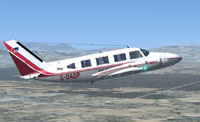
Tuesday, May 30, 2017

Some Tips On Landings And Take-Offs

            
Landings are something we do often.  If you have taken off, you are going to have to land somewhere.  The question is how to do it in the safest and most efficient manner.  A lot depends on what you are flying, how much experience you have and of course, the weather.  Landing a J-3 Cub is a lot different than a high speed single like a Bonanza.  

Factors to consider are of course the wind (speed and direction), type surface (grass or concrete), plane characteristics and of course, pilot skill.  I will go back awhile to landing and taking off at a small airport that had a runway made of asphalt.  Not only were there scattered stones on it, but it had a moderate slope and a tail wind.  Taking off was relatively easy, after you accounted for the stones/pebbles.  You just had not to use the entire runway, but taxi to where the runway became smoother and free of debris.

The take-off went well, just delay full power until clear of the debris.  Delaying full power and watching climb airspeed to be above stall were key.  All went well.  Now for the landing.  As there was a moderate cross wind of about ten knots a alignment was the main consideration.  Not being visually aligned with the runway take getting use to.  Depending on the runway length and the quality of your brakes, airspeed is an important factor to take into account.  

As all went well, there isn't much more to add.  So, adequate preparation before taking off and landing are mandatory for a safe flight.      

Sunday, April 30, 2017

A Turbulent Flight I hope Never To Repeat

It's late in the month and I hate not to have written a blog. Reflecting on some of my past "challenging" flights brings back a flight from Albermarle, NC back to Rock Hill, SC. about a 60 mile flight. For a short while in 2000, I commuted to work at the hospital in Stanley County and back each evening to Charlotte and my hangar in Rock Hill SC. Normally, it should take about 25 minutes or so in the Bonanza, depending on the wind. It was the end of a workday, about 1800 hours, weather was VFR on departure. There was some frontal activity to the southwest, but nothing forecast on my route home.

Well things can change rapidly weather wise, and it sure did that day. Soon after departure I got into some widely scattered clouds and a moderate head wind but otherwise all was cool. Then suddenly it started to get a bit bouncy, light turbulence. I was at 3000 feet but getting jostled up and down a bit with my altitude starting to vary between 2500 and 3500 feet. The turbulence was so great at one time that I could barely read the instruments.  I called Charlotte approach but they didn't have much to say, just some complaints of light to moderate turbulence in the area.

Well that changed quickly as I hit some "moderate" turbulence that nearly flipped the plane 90 degrees over on a wing. This continued causing me concern and forcing me to throttle back to safe cruise speed just above stall. This lessened the severity of the turbulent flight but also meant I was in it longer. Contacting approach control again, no real help offered. As I was getting fairly close to Rock Hill, I kept on flying at just above stall.

Fortunately, everything stayed put. Nothing damaged by the horrific gusts and turbulence.  When I finally arrived at Rock Hill and parked in front of the hangar, and all shut down. I breathed a big sigh of relief. I don't remember ever having been in such turbulence for such a long time, and hope never to be again.

Thursday, March 30, 2017

Oh No! I Forgot To Put The Gear Down


If you haven't yet had a "gear up" you are lucky, or maybe just well trained and careful. Although I have never had a gear up landing, I almost did.  Years back when I was doing some instrument flight training with an instructor in the right seat, I was on short final ready to touch down. The instructor said "have you forgotten something?"  I had not put the gear down.  That was a close call, but my only one, with over 4,000 hours of flying.  I offer a word of advice.  I have a routine which insures that the landing gear is down properly.  I look for the three green lights and think or say "three in the green."   In 2013 NASA reported an average of 60 gear up landings annually and in 2003 there were 96 reported by the NTSB. In addition, I don't know how many landing gear failures (LGF) occurred which may or may not be included under "gear up".

I just read an incidental study that landing gear ranks second after engines as systems prone to failure.
This is really a separate issue than routine gear ups. That is because the pilot at least tried to raise or lower the gear, but a mechanical situation prevented it from happening. Just to give you an idea of the more common causes of (LGF), I'll relate some given by DVI Aviation*.
          Improper rigging
          Improper repair or maintenance
          Improper installation of parts
          Parts worn beyond allowable service limits
          Failure or fatigue of parts
          Lack of lubrication and or hydraulic fluid
          Etc.

Finally, from a study by Canadian Aircraft Maintenance Management Information Systems**,
largely dealing with military planes, the following was found.  In surveying over 200 landing
gear structural component failures, the main mechanical problems involved: fatigue and corrosion.

So, in summary. Get your landing gear and related systems checked regularly, at least once a year.
During your landing approach, VFR or IFR say "three in the green" at least two or three times, after the gear has been deployed.  Happy, safe landings!

* DVI Aviation-Aviation Safety Experts
**Failure Analysis of Aircraft Landing Gear Components 1992
       

Tuesday, February 28, 2017

One Pilot's Path


I'm smiling as I look back at my first log book.  The first entry is on November 4, 1961.  Yes, I know that's going back some 56 years, that puts me at 21 year old.  I was taking my first flight lesson in a military Pa-18 at Felker Army Air Base located at Fort Eustis,Va. just west of Newport News. Back then I did a total of only 15 hours of flight time.  I just didn't feel comfortable flying then.  Mostly because I felt the instructor, a military pilot, was over bearing.  That pause lasted until May 9, 1965 some 4 1/2 years until I started again at Tew Mac a small airport in Massachusetts some 17 miles north of Boston.  The Piper J-3 I flew was owned by the flying club I joined while with the Avco Corp in Wilmington, Ma.

The point of all this, I guess, is to reflect on and pass on to prospective pilots how one can get started in aviation.  It seems important to me as now one hears so much of flying schools and various other programs.  I am glad I did it as an individual rather than as a member of some flight class at a flight school.  Somehow I developed a sense of independence and a progressive self reliance, rather than being led by the nose in a more structured program.

I persisted along this path for some 40+ years.  After getting my first license as a private pilot, which allowed me to take passengers, I kept on going.  Next, I obtained my instrument rating which allowed me to fly in bad weather.  I went soon after for my commercial rating which meant I could fly for hire. Finally, I went for a multi engine rating.  Mainly I did this so I could fly a company twin engine plane as a radiologist in upstate New York.

I would like to mention a couple of memorable flights that still stand out. The first, flying a J-3 Cub out of Tewksbury, Mass. north along a small river at about 500 ft. It was warm and I could leave the fold out windows open, really enhancing the feeling of being alone in the air. It felt so special to me, on one of my first solo flights. The other was years later out of Burlington Vermont. I was on call for emergency flights and I got a call at about 2330 hours. A skier at Lake Placid had taken a bad fall and needed high level medical help only available in the Burlington Vt, area at that time. So off I went in a Piper Navajo, a moderate sized 9 seater equipped with deicing etc., and made an instrument landing at Adirondack Regional airport. The weather was moderate IFR allowing for a safe approach and landing. The ambulance was waiting. We loaded the patient and his nurse aboard, took off IFR and were back in Burlington in 25 minutes. It was one of my most satisfying flights.  

Every pilot's flight path is different.  I thought I would share some of my experiences with you.

Saturday, December 31, 2016

How To Fly And Survive

Over the past five to six years, I have been writing about some of my flight experiences of the past 40 or so years.  I have used this blog as the recording medium. The goal of this writing is to share these flight experiences in an effort to help fellow pilots avoid senseless and possibly fatal flight accidents.

Let me offer an example of how not to do it.  Going back to 1967 in Syracuse, NY, where I was attending medical school, I needed to go to Boston for a quick visit.  To accomplish this I rented a Cherokee 180, marginally IFR equipped for the trip.  Three fellow students joined me.  Weather forecast was VFR, with some possible IFR.  This latter point is key.

My flight experience at the time, about 400 hours of VFR flying with some IFR instruction.  We left Syracuse under beautiful VFR conditions.  Some scattered clouds and a west (tail) wind of 20 to 30 knots.  This is important.  Flight distance about 260 miles, which meant a flight time of just under 2  hours at an airspeed of 120 mph (107 knots).  Landing was planned for Hanscom Field, about 20 miles west of Boston. 

After takeoff we climbed to 7500 feet, with a cruise speed of 150 mph (133 knots), thanks to the tail wind.  Sounds good, but wait. After passing Albany, it started getting cloudy, scattered to broken clouds.  This caused concern, especially as flight service advised possible marginal VFR for Boston at our ETA. So we continued until just west of Worcester.  Flight Service advised that Worcester was going IFR as was Boston. So, what to do? As I was not a fully trained or certified IFR pilot, I need VFR conditions to fly legally and safely. I decided to do a 180 degree turn and head back to Albany and Syracuse.  Fuel gauges showed somewhat more than ½ on both sides. That should be plenty except for the strong west wind!  Ground speed was now of the order of 80 mph per hour (70 knots).  Oh my.  Do we have enough fuel to get to Albany or Syracuse?  Well, in the interim, Albany was now IFR, also. That left Syracuse as our final alternate/destination as it had stayed VFR.  But, would we have enough fuel to make it? 

Since I am alive to write about it, you know we made it. Yes, but barely. As we approached Syracuse, the fuel gauges were hovering around E.  After taxiing in and shutting down, I looked in the fuel tanks and didn’t see any gas.  OUCH! 

The moral of this story.  Always have enough fuel aboard to fly another hour after landing as a safety measure. 


*www.operationsafeflight.blogspot.com   

Tuesday, December 29, 2015

Another Holiday Has Successfully Come And Gone....

Screenshot of Piper Navajo in flight.                                                                                                                        Another Holiday has successfully come and gone, our tree is still up. Looking forward to a pleasant and relatively quiet New Year. I have been doing some reflecting on things, appropriate to the year's end, and decided that this would be my last Operationsafeflight blog for a while. I have been writing articles since February 2009, and covered just about all areas that have concerned me.

My goal has been to help pilots adopt safer flight procedures, and offer some suggestions and cures where appropriate. My plan is to write articles less frequently. I will also be open to answering questions submitted to me


            Walter F. Erston, MD can be reached at:
            www.erstonwf@gmail.com


Wednesday, November 25, 2015

Sometimes I read Things In The Newspaper That Really Scare Me....


Reading an article in the local Charlotte paper on doing away with required flight physicals taught me a lesson. Don’t believe everything you read, and do check the facts whenever possible. The Charlotte article stated that Senator Inhofe’s PBR2 would essentially do away with a required medical exam for Class 3  (private) pilots. Instead pilots would just write a note in their log every four years, that they’d been to see a physician.  Looking further into what was written, according to Joan Lowy of the AP, “a pilot would double the time allowed between exams for pilots over age 40 from two to four years, so long as they also held a valid driver’s license. Instead of a government-certified medical examiner, pilots could see any doctor they like”. It went on to state the doctor would not have to certify to the FAA that the “pilot was healthy enough to fly”. I am shocked at the proposal and worried that something like that will get enacted.

Flying is not like driving a car. There are so many other things to consider, in addition to simple road maps and traffic signals, such as the subtleties encountered in flight like weather, aircraft performance, navigation and communication to name a few. Even at its simplest, the challenges can be huge, and are either met or calamity may occur. That is why I believe physical and mental condition evaluation to be so important.

Just to reiterate an experience I had when flying the right seat in a Pa-34 Seneca, I had to take over landing at a Cleveland airport under IFR conditions when the left seater suddenly felt ill and was unable to continue. It turned out that he had missed getting his flight physical, which most likely would have detected the condition that caused this problem.

In summary then: I strongly encourage the continuance for required flight physicals for all categories of pilots. The spacing between exams may vary, but the exams are not to be done away with.  I strongly endorse the requirement that all pilots obtain a flight physical during their flight career.  The time interval between exams is a separate issue, that I won’t get into here.

Another issue I would like to discuss is weather, particularly thunderstorms. I recently came across another discussion of the hazards associated with flying when thunderstorms are around. This becomes an issue when one is flying IFR under radar control, or when VFR with the bad guys out there somewhere. If one is under the eye of a controller, don’t assume that they will always steer you or advise you safely around a dangerous cell in your path. Particularly, in busy air space like New York, Boston or Atlanta, to name a few, the controller may be just too busy to pay attention to all on his screen. I remember having to dodge a cell because I received a warning too late, and almost lost the plane. Now with radar aboard, and a pilot familiar with its usage, the odds get much better. Again, remembering one radar experience I had that almost ended up badly, because the radar set just couldn’t penetrate the storm adequately for me to see a clear path through it.

My advice is: don’t try getting through an area of storms unless you have a clear, accurate picture of what’s ahead of you and have the experience to handle it.  A 180 degree turn often can be a life saver.

Hope you have a happy Thanksgiving. Fly well and safely.


Tuesday, October 27, 2015

With Winter On The Horizon, It's Time To Start Thinking Of Things Like Ice, Snow And Sleet......

With winter on the horizon, its time to start thinking of things like ice, snow and sleet. Three things that can cause real danger to the casual pilot, and are best avoided. I had flown in to Monroe airport (EQY), just east of Charlotte, to be together with my wife for a weekend. As there was no hangar space available, I had to park the plane, a Cessna 340, next to a hangar outside in the cold. There was the possibility of some snow or ice, so I kept my fingers crossed. After spending a nice two days with my wife, it was time to fly back to Wilmington (ILM), just forty minutes away to the east. As there had been some precipitation, rain snow and even ice, I was concerned about what we would find. As it turned out, things were not good. There was a covering of light snow and ice over the entire plane.

It was Sunday evening, so no help from the FBO, which was closed. My wife and I just started out getting off what we could. We were dressed warmly, and fortunately had gloves on. We sure needed them as the hand broom just dealt with the snow. The ice would have to gotten off by hand. This was accomplished by banging on the ice where ever it was reachable. The areas of most concern were the airfoils, particularly the leading edges. Amazingly most of the ice on the rounded portions of the wing and tail, did break off when struck by our gloved hands. The flat portions of the wing did not want to cooperate, and we didn’t want to dent them either. I believed that getting the front portions of the ice off would suffice. Props had electric deice strips so no worry there. The plane was not heavily loaded. Take off would be done with some excess airspeed to offer a bit of a cushion, in case lift was lost.

Before climbing into the plane, I hugged my wife and reassured her, that I would test things out before actually lifting off. This was done to avoid stalling the plane due to the presence of residual ice. Taxiing out to the runway, I had a good feeling, that all would be OK. After a brief run-up, with prop heat on, I applied full power, feet pressing hard on the brakes. Things felt normal and off I went. The plane accelerated normally, so I gently applied pulled on the control wheel. The nose started to lift and airspeed seemed about normal, so I continued the take off. Climb appeared normal, and I even saw some of the residual ice break off the wing. Good riddance. And that was that. I felt quite lucky about how things had turned out. On landing at Wilmington I phoned my wife, and was pleased to leave an ”arrived safely” message. The reason for the message, was that I got to Wilmington before my wife drove back to our home in Charlotte.

Icing shouldn’t be treated casually. Each plane can respond to icing in a specific manner. Differing airfoils, power plants etc. all contribute to unique handling characteristics. The best advice I can offer is to avoid ice if you can. 

Saturday, September 19, 2015

Same Old, Same Old..............

It seems that I have written about the type accidents that are occurring over and over again. Things like forgetting to lower the gear, or crashing alongside or off the runway in the weeds because of inattention. No one wants to read about them again. And, I don’t feel like dealing with them now either. So I am just going to relate some flight adventures of my own. Yes, maybe I will repeat myself.

Remembering some of my earliest flights as a young student or a neophyte private pilot, makes me laugh and groan a bit. For instance shortly after getting my private ticket, I invited three of my buddies for a short flight to the coast. Taking off from Tewksbury, MA., on runway 21, I dutifully turned south according to the DG (directional gyro). After a short while I noted the hills were getting more prominent and wondered why. Finally cross checking the DG with the compass I figured it out. I had set the DG off by 180 degrees. Nowadays, many DG’s are automatically linked with the proper magnetic heading, eliminating this sort of error. By the way, the trip finally went well, and we landed at Cape Cod and had a good swim.

One other incident remains solidly embedded in my personal flight computer. I was making a flight check for my instrument rating with an instructor friend of mine, in an Aztec. We had done several approaches and touch and go’s and were on a final flight. This had been a no gyro approach to simulate instrument failure. I guess the additional stress of doing something unusual contributed to my forgetting to complete my pre-landing check list. As a result as I was about to touch down the instructor calmly said: “ Aren’t you going to put the gear down?”. Wow, did that make an impression, as I added power and went around. I never again failed to complete the pre-landing check list and drop the gear. Yes, I firmly believe in check lists. Just keep them as simple as possible, and use them faithfully.

That’s it for now. Fly often and safely.

Wednesday, August 26, 2015

Planes Colliding End Up Badly.........

Image result for pictures of small planes colliding crashesA phrase you must have heard a thousand times: “there is nothing new under the sun” applies to bad landings and resultant sequelae. In the latest FAA accident happenings 5 out of 5 accidents involve landings and the day before 7 out of 17. Typical errors such as: hard landing, busted left main wheel, struck prop etc. As I have dealt with these before, I don’t want to belabor it now. But If I had to use one word to help pilots reduce these errors, it would be PRACTICE. Practice makes perfect, is a phrase commonly thrown about. It would be great if   one’s practice always made a positive change in piloting technique. No guarantee, but go out and try, so you have a better chance to beat the odds.

Changing gears, we have recently had an awful (avoidable?) mid-air accident involving an F-16 fighter jet and a Cessna 150. The pilot and his passenger, his father, died in the crash. The military pilot was able to safely eject. The F-16 was IFR, the C-150 VFR. The F-16 pilot was in radio contact with the radar controller, the C-150 was not.  The controller advised the jet pilot that he had traffic ahead, and if not in sight turn left 180 degrees.  The jet pilot replied by asking “confirm 2 miles?”.  The controller replied “..if traffic not insight turn left heading 180 immediately”. Over the next 18 seconds the track of the F-16 began turning southerly. Ouch! If you ever have an “immediately” order, you must do exactly that. Lean on those controls, nice steep bank up to 60 degrees if needed. That is not a casual order. The result here was a mid-air with two innocents buying the farm.

Another landing accident, albeit somewhat unusual, involved a Socata TBM700  landing in Wisconsin. Apparently the plane was on short final and decided for an unknown reason, to initiate a go-around. Now the TBM700 is a turboprop with an engine that can deliver a lot of torque to the prop rapidly. If flown slowly as on short final, the throttle must not be shoved full open too rapidly as the large amount of torque delivered to the prop, can overwhelm things. This apparently happened here with tragic results. The plane supposedly went into a steep left turn, stalling and crashed into the ground. According to Socata, there have been 36 crashes between 1990 and 2010. This included 6 crashes where pilots applied power while landing with resultant stalls and crashes. Power must be applied “steadily and slowly to full climb power”, as related by a Socata instructor.

So that’s it for now. Enjoy the coming cooler weather, and watch that power application.


Sunday, July 19, 2015

Lately It Seems That Nose Wheels Are Being Busted......

Lately it seems that nose wheels are being busted as if they were meant to be destroyed. In a recent FAA accident report, there were no less than “six nose wheels destroyed on landing” reported on a single weekend. Wow that takes some doing. The thing that really got my attention was this occurred in six different models, including a small twin. What I would like to know is: how does one destroy a nose wheel on landing? The only answer I can come up with is this: by landing with full aircraft weight on them. This means that the pilot failed to properly flare the plane, bleed off airspeed and then touch down on the mains. Occasionally a three point landing can be done, but carefully after slowing down properly, with enough back pressure on the elevator to shift most of the weight back on the mains. This can be a useful procedure in a short field situation, where braking immediately after touchdown is required.*

I remember one flight in my B-55 Baron. It required landing on a short 1950 foot runway at  night. Little if any headwind, so braking would be at a premium. It was marginal VFR, with slightly limited visibility.  It was almost straight in after following the VOR procedure approach, speed down to 95 knots, partial flaps gear down and runway in sight. Half a mile to go, time for a GUMPP check. That stands for: Gas, Undercarriage, Mixture, Props, Pump (fuel). OK, three in the green, (something so important to check).** Coming up on the threshold lights, start easing the power back, check props full forward  (again a must if a go-around is to be done). Start back pressure on the control wheel, pulling the nose up and slowing the plane. But not enough to stall.  Now this is key. I want to land as flat as possible as I will be stepping on the brakes as soon as I touch down with the mains. If the nose is up high, the nose wheel would slam down as the brakes take hold. Following the protocol I was able to stop well before the runway end, not even close to the runway end red lights. You can too with some appropriate practice!

 In summary: to avoid slamming down the nose wheel when landing, the goal is to land on the mains, with one exception offered above (careful three point landing). This requires attention to airspeed and attitude. Enjoy your flying, practice and be safe.


*Advice offered here is rather general, and not meant to counter anything “your” instructor might say. It might best be classified as: Food For Thought.
**Recently I read about several moderate sized turboprops landing “gear up”.


Saturday, June 20, 2015

Recent Private Plane Accidents Are Rather.........


             Piper PA-28 -140 1966 Cherokee

Recent private plane accidents are rather “ho hum”. Yes, more of the same and boring. For example let me list some of the recent accidents. There were five “went off” the runway landings. Several with add ons like: into the mud, struck runway lights and/or struck prop. Two “force landed” in a field, one on a golf course. Two “nosed over” on landing and another flipped over.  That was just in three days. Having landed safely many hundreds of times in all sorts of planes, I just can’t imagine doing all this nonsense. 

I read an interesting article: ”Why Private Planes are Nearly as Deadly as Cars” in Life Science dated February 5, 2015. Here some of the main points:
1.      Accident rates essentially unchanged over past decade.
2.      2010 NTSB report : 1 death every 100,000 flight hours. While accident and
fatalities are down in corporate and business jet flights, Accident rate in personal flights increased by 20% in past decade and fatality rates are up by 25%.
3.      Comparing auto and plane deaths, it is 19 times more dangerous stepping into a private plane.
4.      Why do general aviation planes crash?
a.      The number 1 reason is Loss of Control.
b.      Number 2 reason is flight into IFR conditions by those untrained in instrument flight. This frequently results in fatalities.
5.      A reason why so many accidents is suggested by the author: recurrent training is required only every two years for private ticket holders. Long time for those who don’t fly often. (When I was flying commercially, I had a check ride every six months).
6.      According to the AOPA: twice a week a plane crashes because of running out of gas. That I consider is too dumb to discuss. I came close to it once early in my flight career. So I speak from experience.

But no one is perfect.  Please read below about an early misadventure of mine.  

I might as well fess up to that flight alluded to above. It occurred  in the mid to late sixties when I was in my second year of medical school. Three of my fellow students and yours truly had friends in Boston and wanted to visit them over a late fall weekend. So I made arrangements to rent a Piper 140, that was marginally IFR equipped, as was I the pilot, at the time. We headed east early on Saturday in good VFR. Strong westerly’s were blowing. Nice for part of the trip anyway. As we passed Albany, having taken off from Syracuse, we were slightly less than halfway there. So far so good. Great ground speed, but not so weather wise. 

Clouds started forming, but we were still VFR. As we approached Worcester, the picture got a bit scary. The weather there included some isolated snow showers with some reduction in visibility. I called flight service to get the latest Boston weather. Ouch! it was marginal VFR with snow and forecast to get worse, which it did. As I didn’t feel I had the skills to handle serious IFR weather, I decided we better head back west and look for a place to land an reevaluate things. But I hadn’t considered the strong westerly’s, now our enemy as a headwind. Checking the fuel gauges we had about half tanks or slightly better. But with the strong headwinds our ground speed really dropped. Calculating things, I was worried that our fuel supply would be inadequate. I was hoping to land back along our return route but couldn’t. It all was turning IFR. I made the decision to push on, leaning the engine as much as possible to minimize fuel burn. Long story short. We landed back at Syracuse with little better than fumes in the tanks. That was something I vowed never to repeat. A poor piloting job was offset by help from the good fairy, something you can't count on. After that it never did happen again.


So fellow pilots. Never plan a trip so that your fuel reserves will be challenged . The good fairy may not be around.


Wednesday, May 27, 2015

After Having Work Done On Your Plane Have The Mechanic Fly On The First Flight....

It's time to write another blog.  What to choose as a topic?When talking with my wife this morning, this topic came up. What about some maintenance horror stories. Yes, I've had a few, as most pilots that fly a lot probably have too.

Early in my flying career, with a fresh pilots license, this happened. I was renting a Cherokee 140 for a short local hop out of Syracuse. Lovely day, CAVU only a few scattered clouds at 9500 feet. Did a quick pre-flight (too quick). Hopped in and cranked it up. Everything looked good, so off I went. Headed south at 3500 feet, doing some light air work on the way. Just a few steep turns and a couple of 360's. Then wham, all of a sudden some strange sounds coming in from the engine compartment. 
Checking the gages, all looked o.k. Headed back to the airport, intermittent banging sounds, not too loud persist. An expedited landing clearance was granted. Taxiing to the FBO no more noises. After shut down, popped the engine compartment doors open to find a large socket wrench lying free under the engine. Hmmm. How well did I do my pre-flight anyway?


That is just one of several such occurrences until I finally owned  my planes. Which reminds me of some very sage advice given by an instructor pilot and friend years ago. His rule with regards to plane maintenance was this: He who fixes it will accompany the pilot on the first flight made after the work is finished. Now that is an incentive to do careful work.


Finally I will relate another event I experienced that violated this rule. I had a B-55 Baron for some time and wanted to sell it and move on to another plane. Got an interested party in Indiana willing to pay the asking price. I just had a rebuilt engine installed a few days prior planned departure. Did a quick check ride. Everything seemed all right. So off I went on this 3 to 4 hour flight. Nothing remarkable in the air, all systems seemed o.k. But upon landing and on the taxi to the terminal I noted something dripping from the left engine. After shut-down there was a large oil puddle under the engine, unmistakable for a leak. Well the proposed new owner and his mechanic loved it. Long story short. I had to catch an airliner back to Syracuse, where I had a work commitment. We settled for $5000 less then the "agreed upon" price.


The moral offered by my loyal friend-mechanic had not been followed, and it cost me.

So here is my rule. 

When ever a plane has significant maintenance, have the mechanic go on the first flight.  

Saturday, April 25, 2015

A Ride I Would Never Forget...........


Thinking over what to write my next blog doesn’t immediately yield a topic. After all, there are only so many  subjects to consider.  So I have decided just to relate one or the other of my “flying adventures”.

One that comes to mind goes back to my time as a second lieutenant in the Army Transportation Corps. Always gung-ho to hop aboard any flying machine that would take me, I hitched a ride on a small chopper I never would forget. Arriving at Felker Army Airfield on Fort Eustis, I noted a pilot walking out to his helicopter and quickly tagged along side. He invited me, a young gung-ho 2nd Lieutenant to hop in. I gleefully did, sitting to the left of the pilot.Strapping in tightly, I surveyed the open doorway a bit anxiously. No doors on either side. The seat and shoulder belts had better be strong. They were. The engine noisily revved up and we were shortly up and off. I remember the ride as choppy and exciting. We cruised around at  below 1000 feet surveying the base and surroundings. All of a sudden there was a loud “pop” and the pilot yelled into the headset “lean out and see if we are on fire”. I tried to look around , while seated tightly down. The pilot yelled “get out and look in back”. He was expecting me to step out on the landing structure and have a look. No way was I about to do that. I was scared! He read my hesitance correctly and burst out laughing. Very funny I thought. We headed back after that, and I happily got out, never to ask another chopper pilot for a ride.

As far as aviation accidents and mistakes go, nothing really new. Every day I read about gear up landings, taxiing mishaps and various gear problems. The solution to many is just proper training, maintenance and practice, practice and more practice.


So from Charleston, SC, I wish everyone safe and happy flying.

P.S. Comments welcome!

Thursday, March 19, 2015

Beware When Hand Propping.................

 
Reading about a “hand propping” accident involving a Pa-18, on the FAA accident site brought back some good old memories, fortunately no bad ones. In my early flying years, I had the opportunity to fly a Pa-18 (Piper Cub). It was bare bones. No electrical system. That’s right, no lights or radio. Better have a flashlight aboard and plenty of batteries. One thing I learned early in the game, was to tie the tail down when hand propping. If not, well say bye-bye and run fast and catch up or else. There were some other things I did as well. I looped the seat belt around the control stick to apply “up” pressure on the elevator. Made sure the throttle was just barely “cracked” open to help prevent an engine runaway. Usually the engine would start on the second pull after the initial propping to prime things. Once started, with chocks still in place, run back and untie the tail. Hold on to the fuselage as you go, pull the chock and hop in. Yes it did take some coordination, but in those days I was able to.

Just to expand on the type accident that can happen, I’ll mention a few I just read about. The first one makes the skin on the back of my neck crinkle, it’s so scary. While refueling their tail dragger, apparently with the engine running, the plane taxied away and smashed into several other planes. Ouch! Two days later, at another field, a C-170 also being hand propped, went off on its own into nearby planes and stopping only after ramming into the hangar. That’s a lot of money to waste because of forgetting to do such an easy thing. Money is one thing, but what about personal injury?  

While on the poor piloting thing, here are some recent ones. On the FAA site of 16 March there were three nose wheel collapses on landing, listed, one after the other, on three different aircraft types. They were a Commander 114, a C-172 and a C-421, three very different birds indeed. Reasons are generally not given on the site, so one must speculate. I have to guess that just maybe they landed too hard and fast on the nose wheel, rather than on the mains. Poor maintenance of course may be a factor.

Finally there were four “off the runway” landings listed on the 17 March 15 FAA site. All very different birds. The first was a Grumman 164 that force landed “short”. Next was M-20k, “landing off the runway”. No reason given. Then a C-340 (plane dear to my heart), landed long, stopping in the overrun in a damaged condition. I have to mention that airport had a 4800 foot runway, more than enough length for that type plane. Finally, a lightweight type sport plane, landed off the runway and flipped over. Remember that excess speed demands excess braking and a longer distance than may be available. Also, many smaller planes, types I have flown, have limited braking available.

The moral of all this is to get recurrent training at least annually. Do very thorough pre-flights, particularly looking over the landing gear and brakes, getting professional opinion when needed. When practicing, be critical and  get check rides often.

P.S. Comments welcome!

Friday, February 27, 2015

Don't Have A Bad Day, So Don't Land On the Nose Wheel.....


If you touch down on the nose wheel first, you have a good chance of causing serious damage. Depending on factors such as speed and weight, the nose gear might collapse and then who knows what. The prop will be damaged, probably the engine and fuselage. You certainly will have a bad day.

Reading in Aviation Safety* that 40% of accidents are landing gear related, would help explain why I see it mentioned so often. I couldn’t find the stats on how many “bad” landings were of the nose wheel type. But I think way too many. Causes include: poor training, excess speed, short fields etc. When a pilot comes in high and fast and tries to force the landing, that’s the setting for gear and particularly nose wheel damage. Another bad scenario can occur when a stiff cross wind is present. Trying to force a plane, particularly a high wing type like a 150 or a 172, can be the setting for serious gear trouble.That’s when one reads about gear breakages, flips or rolls or worse. The only way to prevent these type of accidents is to train properly, using an instructor when needed.

I have a flight in my first log book, that I’m not proud of. I was flying a Cessna single, either a 172 or a 182, into Nedrow Airpark, NY38. This was a 2100 foot strip of asphalt, aligned 3/21, with 50 foot trees at the north end. I was a relatively low time private pilot, in my first year of medical school in nearby Syracuse. I had arranged to meet an old friend there and was anxious to get together. The wind was out of the southwest and a bit gusty so I decided on a runway 21 landing. The only problem was a 50 foot tree at the north end . Instead of doing a trial pattern of this small field, I rushed things a bit. Worried about the trees at the north  end I came in a bit high, but also slightly fast. The combination was disastrous. At midfield I was just barely able to touch down. I “stood” on the brakes, but I couldn’t slow the plane enough to prevent it from going over the far end into a tree, that did stop me. I was lucky and had no serious injury, just a bruise. The plane however received serious damage to engine  fuselage, and nose gear. I was very glad it was insured.

I am happy to say that was my only airplane accident, other than slightly scratching the outer wing tip of a plane while taxiing. So, fellow pilots, practice your landings often, and pay particular attention to speed and whether it is a two or three wheel affair. If it is a three wheeler, be gentle on the nose wheel  or be prepared for a big bill.

*www.AviationSafetyMagazine.com (Why can’t we land?)

P.S. Comments welcome!

Tuesday, January 27, 2015

Flying A J-3 Can Be Loads Of Fun, But Once In A While Things Can Go Wrong....

Private HB-OCU aircraft at AmbriPreparing for writing the next blog is an interesting task (most of the time). Lately I have been made aware of so many accidents related either to the take-off or landing phases of flight, that I started to read about the landing and take-off processes.* This a wonderfully written article, with many superb illustrations, both diagrammatic and photographic. Not only are details of the various types of gear given, but also the problems related to the take-off and landing processes and their relationship to the landing gear.

The illustrations are just fabulous. Details of the simplest brake systems, with just one disc rotor to multiple disc systems used on large aircraft. Discussions include complicated things as anti-skid systems for airliners, not something a small plane pilot need worry about. But what is valuable is the discussion  of the testing of brakes and brake systems for small and large planes. This includes  checking  brake fluid and the subsequent addition of fluid if more is needed. The replacement of brake linings is covered, as well as brake adjustment.

Finally, tires are fully discussed. This includes the various types, as well as inflation procedures and pressures. Complete assessment of aircraft tires is covered as well as “how to do it”. This includes tire inflation, tread inspections and repairs if needed. The article ends with how to protect your airplanes tires during taxiing, take-off and landing.

In summary:  This article is excellent reading for any pilot, but especially for those doing some of their own maintenance

This all brings to mind an incident from years ago when I was happily and nonchalantly flying around the Boston area in an old J-3 Cub. The weather was warm and the side window flaps were up, offering the best visibility of everything out there and wonderful “air conditioning”. As I had been flying for about an hour, and the fuel dip stick was getting low, I decided to head back to Tew- Mac field, North of Boston. (This airfield has since been closed.)  As I was looking down at something of interest on the ground, three hundred feet below, I happened to see something funny on the top of the right tire. There seemed to be a cut in the tire, which looked like a small flap of rubber.  Oh-oh I said to myself and decided that the landing had better be gentle. A blow out would not be fun, and would probably lead to an unplanned 360 degree turn and possible roll over. I decided to land as gently as possible on the right main and hope for the best. Well, happily it turned out fine. The tire didn’t go flat and was replaced.

So, pay attention to your landing gear and all associated systems.  Do this both in pre-flight and post-flight. If you can do so while in flight, so much the better. Have fun up there, but do look around.

*www.faa.gov/regulations_policies/handbooks_manuals/aircraft/amt_airframe_handbook/media/ama_Ch13.pdf

Wednesday, December 31, 2014

Have A Happy And Safe 2015, Fly Right......

    Well it’s New Year’s Eve and all goes well, unless you are one of those “pilots” I have been reading about on the FAA accident reporting site. I really do wonder what makes those pilots tick that make it to the internet site. Why don’t you read it for yourself and think about it?

Here are some examples of their doings:
                Gear up landing,
                Damaged nose wheel on landing,
                “Gear collapses upon landing” or oops I’ll push the handle
    down now and HOPE for the best,
                Damaged landing gear on hitting runway or taxiway lights,
                Wing damaged as hit other plane or hangar etc.,
                Crashed on take-off due to engine failure (or oops should
    have done proper pre takeoff run up),
                Gear damaged due to drifting off runway or taxiway,
               
 And so on, the list almost endless.

Have a Happy and a safe New Year. If you are planning to fly, please stay off the FAA accident reporting sites.

See you in 2015


Tuesday, December 16, 2014

Flying An All Digital Glass Cockpit You Had Better Have Some Analog Back Up.........

As it is approaching Christmas, I am going to offer a present early, an abbreviated blog. Do I hear you cheering out there? Well, here goes. This is aimed at you digital types, with all glass cockpits. In case you missed it, all glass.  Do you have any back-up analog instruments? No. Well here is why you need them if you do any IFR flying in real weather conditions.  Let us suppose that you are on an ILS  instrument approach with a visibility of ½ mile and a ceiling of 200 to 300 feet. I’ve been there many times and it not only requires precision, but an alternative option. The option to quit the approach if it is not working out, for whatever reason.  What if at the last few feet of your descent, the digital (glass) system fails? Yes, just goes blank. If you have your analog gauges insight and working, you should be able to institute a missed approach.

Why am I going there? Because in reviewing  some glass cockpit configurations, I fail to see a complete or good partial analog back-up system. At the very least there should be an airspeed indicator, artificial horizon and altimeter. What about compass heading, rate of climb/descent etc? I think it could get pretty hairy quickly, especially if you are not practiced in this kind of situation.

Well that reminds me of a trip I had with my boss, and working associate in the company Piper Pa-34 Seneca.  This was all analog back in the mid 70’s. Nice planes as long as both fans were going and if you weren’t in a hurry. I was flying in the right seat, my boss was chief pilot in the left. We were getting vectored  for an ILS approach to runway 28 or 24 at Cleveland’s Hopkins,not sure which at this time. All at once my associate asks me to take over and fly the approach. I was shocked when he admitted that he hadn’t obtained his IFR ticket yet, something I hadn’t known. As I was legal and up to date, I accepted the offer. There was a problem in that I didn’t have a complete set of gauges in front of me and had to look at his for some data. The thing that I remember was craning my neck and struggling to see the ILS needle. Well, anyhow it turned out OK, with us breaking out at about 350 feet above the ground, with the runway barely in sight. The landing was good and we taxied to the gate and shut down all systems. That night I had an extra brew.

The moral here is that you never know when a problem will occur. The better prepared you are, the better you can handle the unexpected.

Have a Merry Christmas,  a Happy Hanukkah or whatever you celebrate, and a Happy New Year.

Tuesday, November 25, 2014

What Are Your Chances Of Getting Struck By Lightning?,,,,,,,,,

In chatting with my son the other day, on his return from another across the globe business trip, he related the following. As his huge four engine Airbus A340 was somewhere in the pre-landing phase the left outboard engine was struck by a bolt of lightning. It was accompanied by a loud bang and lots of smoke. The plane shook and shuddered but otherwise seemed ok. The passengers weren’t however, mostly scared out of their wits. After hearing about this, I decided to do some reading on the subject and write about it here. Fortunately my son’s plane landed safely with no obvious damage.

Apparently getting struck by lightning is a relative rarity. I saw one prediction of one strike in 3000 hours of flight. This was most likely for commercial, airline types, not GA (general aviation) pilots. So where is a GA pilot most likely to encounter a bolt of lightning? According to an article in Av Wx Workshops, “about 90 percent of lightning strikes to aircraft are thought to be initiated by the presence of the aircraft itself”. This would imply nearness to a thunderstorm. To make things a bit scarier (and confused), the article continues: “that 40 percent of all discharges involving aircraft occurred in areas where no thunderstorms were reported.” That reminds me of one of my flights over W. Virginia at 10,000ft. We were in the clear in relatively smooth air, when all of a sudden there was a loud bang, the plane shook violently and we dropped 500 feet with the autopilot disconnected. Now they go on to say that most of the induced lightning discharges occur at temperatures of +5C to -10C, with the highest number of strikes right at 0C. Also, most aircraft induced strikes occur between 10,000 and 16,000 feet MSL. As well, a large number of strikes occur within the clouds, and within precipitation and in-cloud turbulence,*

Another article goes on to clarify things a bit more. They state that the probability of a lightning strike in a thunderstorm increases with altitude (as above). Also that during penetration of thunderstorms at low altitudes, lightning strikes were found to occur in areas of moderate turbulence at the edge of and within large downdrafts.**

Just a bit on damage caused by lightning strikes. Direct effects seem to be caused by electric current flowing through the aircraft skin. Areas that are hit seem to experience extreme heating, with resultant burning and melting damage. Indirect effects seem to be aimed at sensitive areas such as avionics, which are damaged by transient electric pulses and strong magnetic fields. Therefore, unless avionics are properly shielded, they are easily damaged by these indirect lightning effects. Another reference source states that “aircraft incorporating lightning and EMI (electromagnetic) protection have had a significantly lower percentage of electrical failures and interference caused by lightning strikes.***

So try and stay away from areas at risk for lightning discharges. This requires weather familiarity, good planning, use of radar when available and luck.

Happy Thanksgiving.

*AV WX Workshops August 24, 2009
** Jack D. Chapdelaine-P-static testing-Electrostaic interference consultant
***Flight Safety Foundation-When Lightning Strikes